

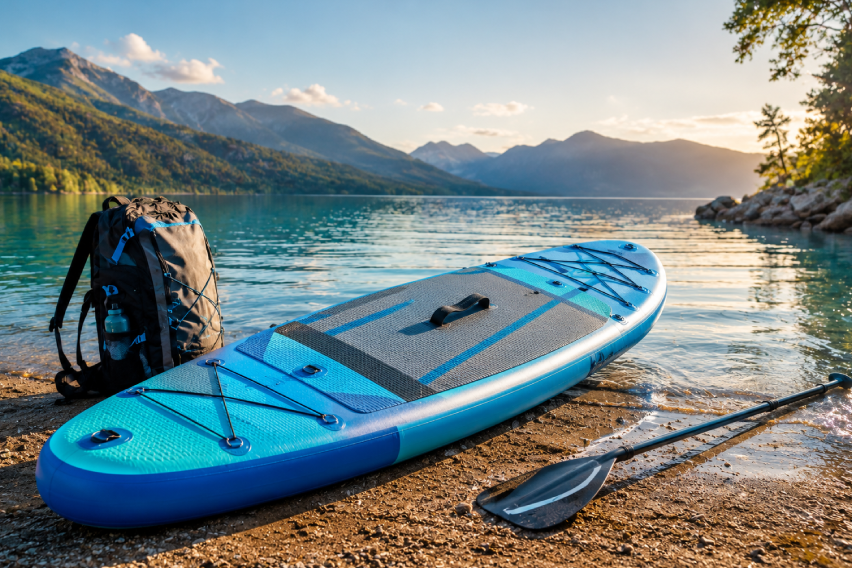
Stand-up paddleboarding arrived in our family’s life three summers ago through the specific path that most outdoor activities arrive: one person tried it on holiday, found it significantly more enjoyable than expected, and the paddleboard purchase followed within a month of returning home.
Three summers later, the paddleboard is among the best purchases we’ve made as an outdoor activity investment. It goes with us to lakes on day trips, to the sea when conditions allow, and has been on three separate holidays. The children who were initially reluctant are now the ones who ask when we’re going. Here is what I’d tell someone buying their first board.
Hard boards perform better on the water — they’re stiffer, track straighter, and paddle more efficiently. For recreational family use, none of these performance advantages are meaningful enough to outweigh the practical disadvantages: hard boards require a roof rack or van to transport, require storage space that most households don’t have, and don’t survive the rough handling that family outdoor activities produce without chipping and cracking.
Inflatable boards pack into a bag the size of a large rucksack, fit in a car boot alongside other holiday kit, can be stored in a flat or shed without dedicated storage space, and survive being bumped, dragged, and sat on without damage. For most families, the inflatable is not the compromise option — it’s the correct option.
The quality variable that matters most in inflatables: the PSI rating and the construction quality that supports it. A board that holds 15–25 PSI produces a stiffness comparable to a hard board. A board that only supports 10–12 PSI feels noticeably softer and paddled differently. The construction — dual-layer versus single-layer PVC — determines how robustly the board maintains its pressure over time and under the impact loading of regular use.
Available at: Bluefin SUP (bluefinboard.com)
Best for: Families who want the best performance-to-practicality ratio in an inflatable paddleboard for regular use.
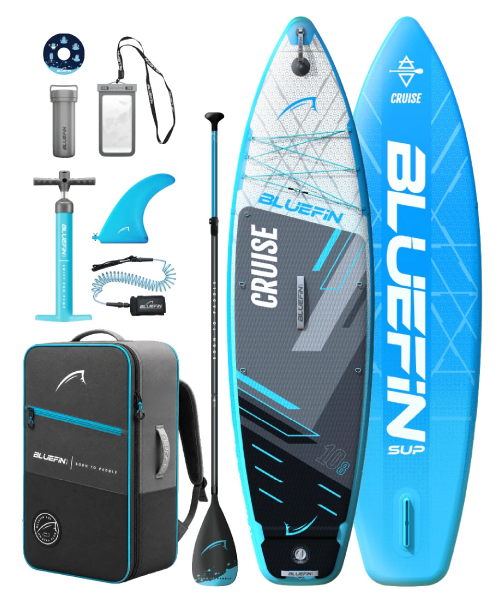
Bluefin SUP produces inflatable paddleboards that consistently receive the best performance reviews in the accessible premium category. The Cruise Carbon is the board that balances performance and price most effectively in their range.
The carbon construction reinforcement alongside the standard drop-stitch inflatable body produces a board that’s stiffer than standard inflatable alternatives at the same pressure. The stiffer board tracks more accurately, responds more predictably to paddle strokes, and provides a more stable platform for children and beginners who are still developing their balance.
The dual-layer PVC construction provides impact resistance that single-layer boards lack. The board survives rocky shorelines, accidental scrapes against boats and pontoons, and the rough handling that family use involves without the puncture anxiety that thinner single-layer constructions produce. After three seasons of regular family use, our Bluefin has no punctures and no visible surface damage beyond minor scuffs.
The included accessories are genuinely complete: a carbon fibre adjustable paddle, an electric pump that reaches the target PSI automatically and stops, a full-length board bag for storage and transport, and a safety leash. The electric pump specifically is the quality-of-life upgrade that makes getting on the water feel effortless rather than like work — it handles the inflation while you organise everything else.
At 330 litres volume, the board handles paddlers up to approximately 130kg comfortably and accommodates an adult and a younger child simultaneously for the family paddle sessions where one child isn’t yet ready to paddle independently.
Available at: Amazon, outdoor sports retailers
Best for: Those who want to try paddleboarding before committing to a quality board.
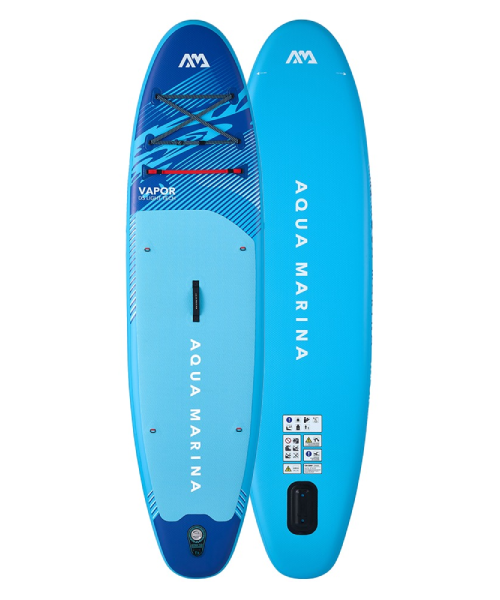
For those who want to try paddleboarding before committing to a Bluefin-level investment, the Aqua Marina Vapor provides a functional starting experience at a price that makes the experiment financially uncomplicated. The board paddles, it inflates, it holds a rider at calm water — the core function works.
The honest comparison: the Vapor won’t feel like the Bluefin in the water, the included paddle is lower quality, and the board is less durable. For a single season of discovering whether paddleboarding is the activity you’ll pursue, it serves the purpose. For a board you’ll use for five seasons of regular family use, it isn’t the right choice.
Start on calm, flat water. The specific paddleboarding skill — balancing on a moving board while paddling — is easiest to develop on still water. Harbours, lakes, and sheltered bays are the appropriate first paddleboarding environments. Ocean swell and river current are for after the balance skill has been established.
Kneel before standing. The transition from kneeling to standing is easier on a moving board than standing from a floating start. Kneeling builds the balance intuition that makes standing less likely to produce an immediate fall.
Keep the paddle blade angle correct. The paddle blade should angle away from you with the blade facing the direction of travel — the natural instinct is the opposite and paddling with the blade facing backward produces significantly less forward propulsion and more wobble.
The leash is mandatory. A board that gets away from a swimmer becomes a hazard to other water users and often a lost piece of equipment. The leash connection between the ankle and the board means the board is always within reach.
Paddleboarding is the outdoor activity that scales most effectively across the family — from small children riding as passengers through to teenagers and adults paddling independently, the same board accommodates different uses as the family changes. Bluefin SUP produces the best inflatable paddleboards in the accessible premium category, with the Cruise 10’8 as the family and recreational recommendation and the Sprint serving performance-focused paddlers. The investment in a quality board pays back across seasons of family outdoor activity that no single-use purchase can match. Start with the Cruise — the stability makes it accessible for everyone in the family from the first session.