

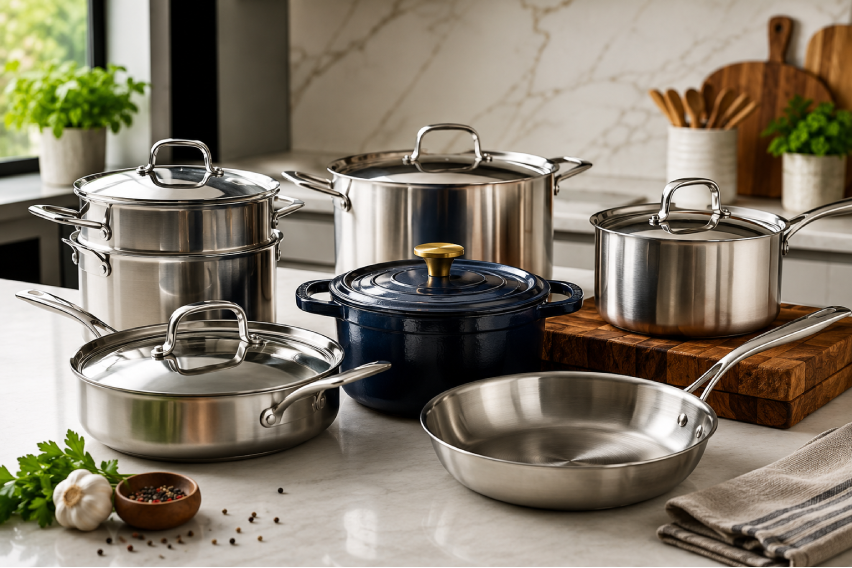
I replaced my cookware set twice in five years before finally getting it right. The first set came from a department store sale and lasted about eighteen months before the nonstick surface became genuinely frustrating — eggs stuck, handles wobbled, and the coating had gone from smooth to patchy in a way that made cooking feel like a chore rather than something I enjoyed. The second was marginally better and lasted two years before the same pattern repeated itself. The third time, I spent proper time researching and proper money buying. That was over two years ago. I haven’t thought about replacing anything since.
Here is what I know now that I didn’t know then — and the specific cookware that I’d recommend based on what they’re actually designed to do in a real kitchen.
The single most important thing about cookware is understanding what you actually cook and at what heat. Ceramic nonstick coatings perform excellently on low to medium heat — they degrade under high heat progressively and irreversibly. If you cook predominantly at low to medium heat for eggs, fish, sauces, and sautéed vegetables, ceramic nonstick is genuinely excellent. If you sear proteins at high heat and build pan sauces, stainless steel clad cookware is the correct material.
Stainless steel has no coating to degrade. It handles high heat correctly, produces proper sears and fond development, and lasts indefinitely. The trade-off is a learning curve: stainless requires correct preheating before food goes in. The water bead test — a drop of water should bead and roll rather than evaporate — tells you when the pan is at the correct temperature. Fat goes in at this point. Food goes in after the fat shimmers. Once understood, stainless steel produces results that ceramic nonstick simply cannot.
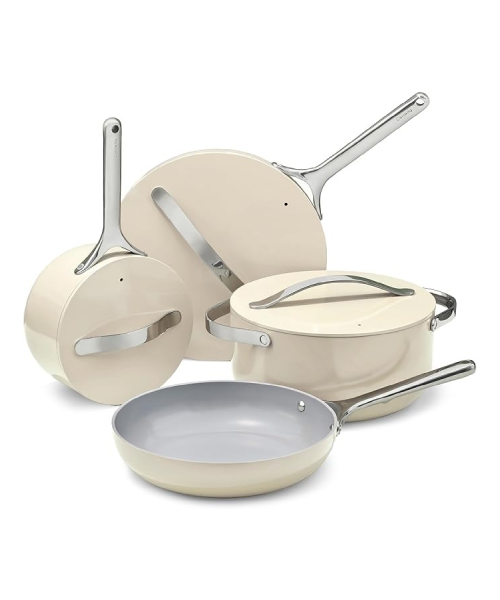
Available at: Caraway Home (carawayhome.com), Williams-Sonoma, Crate & Barrel
Best for: Home cooks who cook primarily at low to medium heat and want beautiful design alongside easy cleanup.
The Caraway set is what I’d recommend to anyone who cooks predominantly at low to medium heat and wants cookware that looks genuinely beautiful in a kitchen. The four-piece set — fry pan, saucepan, sauté pan, and Dutch oven — covers most home cooking situations without the redundancy of twelve-piece sets that include pieces you’ll use twice and then forget about.
The ceramic coating on first use produces the specific satisfaction of food releasing cleanly without effort. Scrambled eggs slide across the surface with a small amount of butter. Fish lifts without catching. The cooking experience on new Caraway is immediately different from nonstick that’s been used carelessly for years.
The storage system that comes included is the detail most often mentioned by Caraway owners and the detail that most changes daily kitchen use. The magnetic pan rack stores three pans vertically — each individually accessible without moving others. The lid holder keeps lids separately organised. The entire system sits on a countertop and looks like a considered design decision rather than functional storage.
The honest care requirement: medium heat maximum. No metal utensils — silicone or wood only. No cooking spray, which polymerises on the ceramic surface and degrades the coating faster than anything else. Hand wash only. These requirements need to be followed consistently for the coating to maintain its quality.
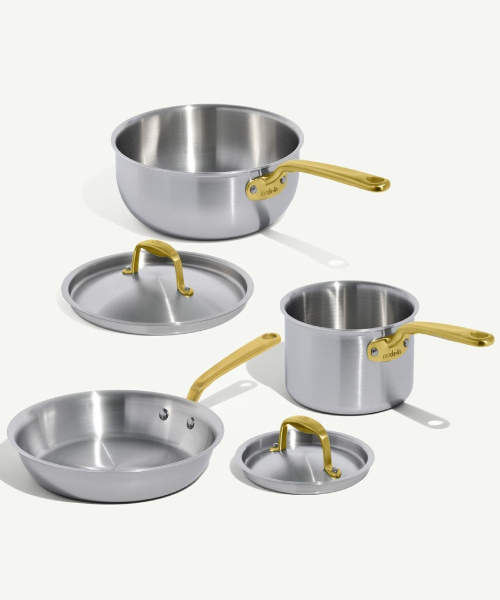
Available at: Made In Cookware (madeincookware.com)
Best for: Serious home cooks who want professional cooking performance and are willing to learn how to use stainless steel correctly.
Made In’s direct-to-consumer model produces professional-grade stainless clad cookware at prices that the professional equipment premium would previously have made inaccessible. The five-ply fully clad construction — alternating layers of stainless steel and aluminium throughout the sidewalls, not just at the base — produces even heat distribution that single-ply or base-only clad alternatives don’t achieve.
The difference becomes apparent in sauces and braises where the sides of the pan also heat evenly rather than developing hot spots at the base transition. Food that contacts the side walls cooks at the same rate as food at the base — the specific quality that produces consistent results rather than uneven browning.
There is a learning curve. The first week with Made In stainless includes food sticking that doesn’t happen with nonstick and requires understanding the correct preheating process. Once learned, stainless produces results that ceramic nonstick cannot: the deep sear on a protein that develops a proper brown crust, the fond that becomes the base of a pan sauce, the high-heat cooking without any concern about coating damage.
The set includes two fry pans, two saucepans, and a stockpot. Made In’s lifetime guarantee and their genuine reputation for honouring it are relevant for a premium purchase — the pan that needs replacing due to a manufacturing defect gets replaced, not negotiated over.
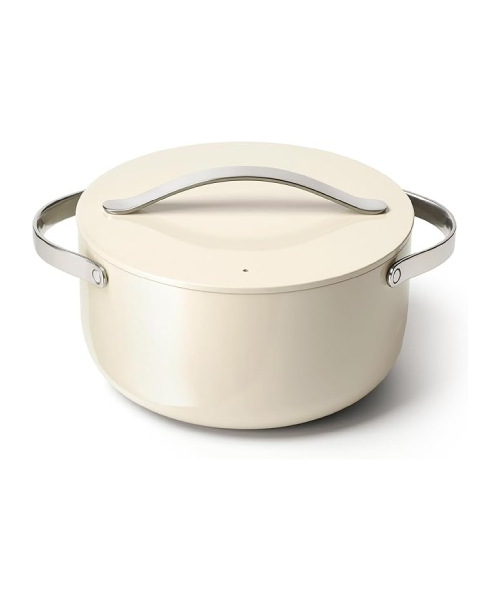
Available at: Caraway Home (carawayhome.com), Williams-Sonoma
Best for: Those who want one quality ceramic piece for soups, braises, stews, and bread baking.
If the full Caraway set is more than the budget or the cooking situation requires, the Caraway Dutch Oven as a standalone purchase is the most useful individual piece of ceramic cookware available at the price. A Dutch oven handles soups, stews, braises, no-knead bread, large batch pasta sauces, and slow-cooked proteins — the cooking situations where a heavy, deep vessel with a lid produces results that thinner alternatives don’t.
The Caraway Dutch Oven in sage or cream sitting on a stovetop is one of the most genuinely beautiful pieces of kitchen equipment available at the price. It’s the piece that elevates the kitchen’s appearance while doing actual daily cooking work. For those who want to start with one quality ceramic piece before committing to a full set, this is where to start.
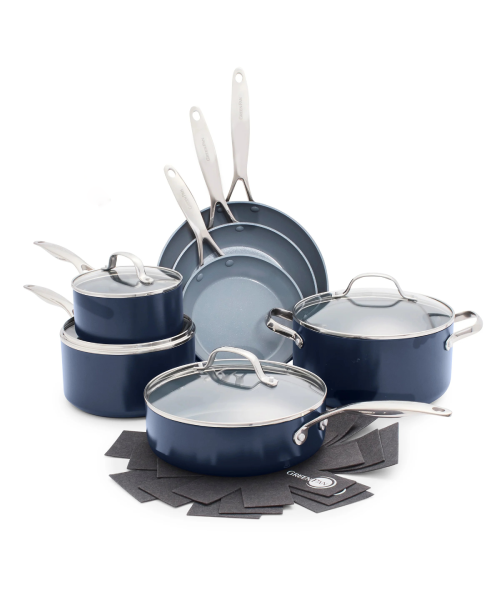
Available at: GreenPan (greenpan.com), Amazon, Williams-Sonoma, Bed Bath & Beyond
Best for: Those who want quality ceramic nonstick at a more accessible price than Caraway.
GreenPan pioneered PTFE-free ceramic nonstick over a decade before most brands entered the space, and the Valencia Pro collection uses their Thermolon coating in a hard-anodised aluminium body that heats quickly and distributes heat evenly. The performance in regular home cooking is genuinely comparable to Caraway, at a price typically $100–150 lower for an equivalent set.
The quality differential from Caraway is real but subtle. The GreenPan coating performs similarly in the first year and slightly less well in the second, based on long-term owner reviews. The Caraway storage system is also a meaningful advantage that GreenPan doesn’t match. For those where budget is a genuine consideration, GreenPan Valencia Pro is a genuinely good ceramic set that delivers the key performance without the full Caraway premium.
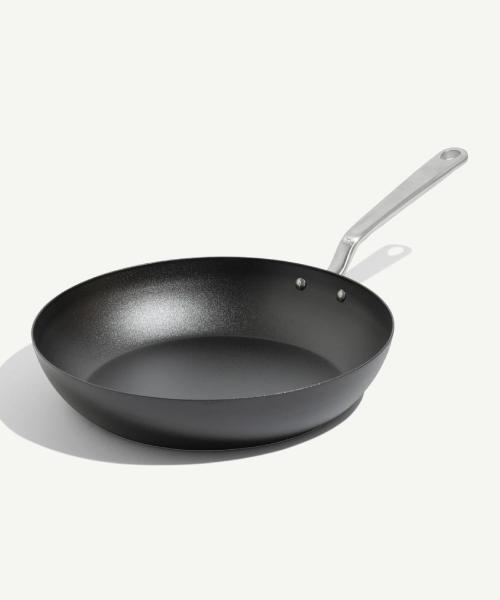
Available at: Made In Cookware (madeincookware.com)
Best for: Those who want to develop cooking skills with a professional-grade material that improves with every use.
Carbon steel is the material that professional kitchens use more than any other — lighter than cast iron, more responsive to temperature changes, and capable of developing a natural nonstick surface through seasoning that rivals ceramic nonstick without ceramic’s heat limitations.
The Made In Blue Carbon Steel requires seasoning before first use — applying thin layers of oil and heating to create the polymerised coating that provides the nonstick character. After two or three seasoning sessions, the surface is ready for cooking. From that point, the pan develops further with every use, becoming more seasoned and more capable over months and years.
This is the opposite of ceramic nonstick, which starts at its best and gradually declines. Carbon steel starts good and becomes exceptional. For those who want to invest in cooking skill alongside cookware quality, this is the pan worth owning.
Match the heat to the material. This single instruction prevents the majority of cookware failures. Ceramic and PTFE nonstick on medium or below. Stainless at appropriate heat with correct preheating. Carbon steel on any heat with seasoning maintenance.
No cooking spray on any nonstick surface. The aerosol oil creates a polymerised residue that builds up and degrades any coating faster than almost any other form of misuse. Apply oil directly to the pan rather than using spray.
Hand wash nonstick regardless of dishwasher-safe labelling. Dishwasher detergent is more abrasive than hand washing soap and the mechanical action of a dishwasher cycle accelerates coating wear. Two minutes of hand washing extends cookware life by months.
Store without stacking. Pan stacking scratches nonstick surfaces where the base of the upper pan contacts the coating of the lower. The Caraway storage system prevents this. For other cookware, pan protectors between stacked pieces are a $10 investment that extends the coating’s life significantly.
The right cookware is determined by how you actually cook. Caraway is the beautiful, easy-care option for those who cook at low to medium heat and want ceramic nonstick that looks as good as it functions. Made In is the professional-grade choice for serious home cooks who want performance without compromise. The Caraway Dutch Oven is the best single-piece investment for those starting with one quality ceramic piece. GreenPan delivers comparable ceramic performance at a lower price. And Made In Carbon Steel is the skill-building option for those developing their cooking with a professional material. Whatever you choose, care for it correctly from the first use — the cookware that lasts is the cookware that has been treated right, not simply the most expensive option purchased.