

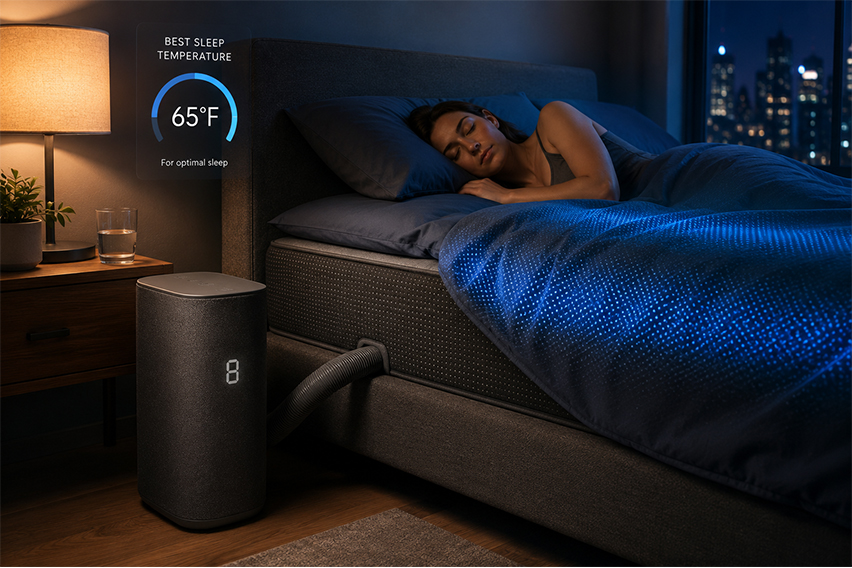
There's a reason hotel rooms always seem to have a thermostat and you immediately adjust it before you get into bed. Temperature is one of the most fundamental factors in sleep quality — not a minor comfort preference, not something you can override with willpower — a biological requirement that your body is actively trying to manage every night whether you help it or not.
Most people don't help it. They set their bedroom thermostat to whatever feels comfortable when they're awake, get into bed, and then wonder why they wake up at 2am or feel like they didn't sleep deeply. The temperature that feels comfortable when you're sitting on a couch is almost never the temperature that optimizes sleep.
Your core body temperature follows a predictable pattern across a 24-hour cycle. In the late afternoon and early evening it peaks. As evening approaches, your body begins a gradual cooling process that signals the brain to start producing melatonin and prepare for sleep. This cooling is not incidental — it's an active physiological process. Your body dilates blood vessels near the skin surface to release heat, and your core temperature drops by one to two degrees Fahrenheit. This drop is part of what allows you to fall asleep.
During deep sleep stages your core temperature is at its lowest. During REM sleep your body's temperature regulation becomes less active and you're more dependent on your environment. This is why sleeping too warm disrupts REM sleep disproportionately — your body can't regulate effectively during REM and a warm environment creates serious problems.
The research on sleep temperature is more consistent than most sleep science. The consensus range for optimal sleep is between 65°F and 68°F for most adults. That range is cooler than most people's instinct — most people would say 70°F to 72°F feels comfortable, which is four to seven degrees warmer than what the research suggests optimizes sleep.
The reason: when you're under covers in bed, the microclimate between your body and the bedding is significantly warmer than the room temperature. A room at 65°F produces a sleeping environment closer to 75°F to 80°F at the skin surface — approximately where the body wants to be during sleep. People who sleep hot often need the room even cooler than 65°F to achieve the right skin surface temperature.
Room temperature is static. Your body's temperature needs change across the night — running warmer during the first half when deep sleep predominates and shifting during the second half as REM becomes more prominent. A room set to 65°F solves the average temperature problem but doesn't address the variation. A static room temperature is a compromise across all sleep stages rather than an optimization for any of them.
There's also the partner problem. Two people in the same bed often have meaningfully different temperature needs. Setting the room to 65°F freezes the cold person. Setting it to 70°F makes the hot person uncomfortable. The compromise temperature makes both people sleep worse than they would at their individual optimal temperatures. And air conditioning has another limitation — it cools the room but not your sleeping surface. The mattress absorbs body heat and returns it to your skin all night.
The Eight Sleep Pod 5 addresses the temperature problem differently from a thermostat. Instead of cooling the room and hoping the effect reaches your sleeping surface, it cools the sleeping surface directly — water circulates through channels embedded in the mattress cover, removing heat continuously from the exact place where your body meets the bed. Your bedroom can be 70°F and your sleeping surface can be 65°F simultaneously.
The cooling is active rather than passive. A cooling mattress topper absorbs heat — it has a finite capacity and once it's full, it stops working. The Pod 5 removes heat continuously. There's no saturation point. At 3am it's doing the same job it was doing at 10pm, which is the fundamental difference between something that works all night and something that works for the first hour.
Rather than holding a static temperature all night, Autopilot adjusts the temperature of your sleeping surface as you move through sleep stages. The Pod 5 pre-cools your bed before you get in — starting the temperature drop your body is trying to achieve naturally. During deeper sleep stages in the first half of the night it maintains the cooler temperature deep sleep requires. Before your alarm it warms gradually — using temperature as part of the waking process rather than a jarring buzzer.
It takes two weeks for Autopilot to learn your patterns well enough to do this properly. The first two weeks are data collection — the system watches your sleep architecture, learns when you enter deep sleep, when you transition to REM, when you naturally start waking. After that the adjustments become genuinely precise.
The couple temperature problem has no thermostat solution. The Eight Sleep Pod 5 solves this with independent dual-zone temperature control — each side of the bed has its own water circuit, its own temperature setting, its own Autopilot profile. One person's side can be running at 62°F while the other is at 74°F. The two sides don't affect each other thermally at all. For couples where one person sleeps hot and one sleeps cold, this is the first actual solution to a problem that has caused bad sleep in millions of households.
Most hot sleepers find their Pod 5 sweet spot between 60°F and 67°F. Most average sleepers land between 65°F and 72°F. Cold sleepers often prefer 72°F and above. The right approach: start lower than feels intuitive and adjust upward if needed. Most people set their first temperature too warm because they're calibrating based on how temperature feels when they're awake rather than what their sleeping body needs. Start at 65°F if you're unsure. Check your sleep report after a week. Adjust from there.
The Eight Sleep Pod 5 is not cheap — the cover starts around $2,195 for a Full size and the membership for full Autopilot features runs $17 to $25 per month. Whether that's worth it comes down to one question: how much is sleeping well actually worth to you? For someone consistently sleeping poorly because of temperature who has tried everything else — fans, cooling pillows, gel toppers, lowering the thermostat — the Pod 5 is the solution that works where everything else failed.
For someone whose sleep issues aren't primarily temperature-related — anxiety, noise, pain, a bad mattress — the Pod 5 won't fix the underlying problem. The 30-night trial makes the risk calculation simpler. You have 30 nights to find out whether temperature is your problem and whether the Pod 5 fixes it. Most people who are genuinely temperature-disrupted know within two weeks.
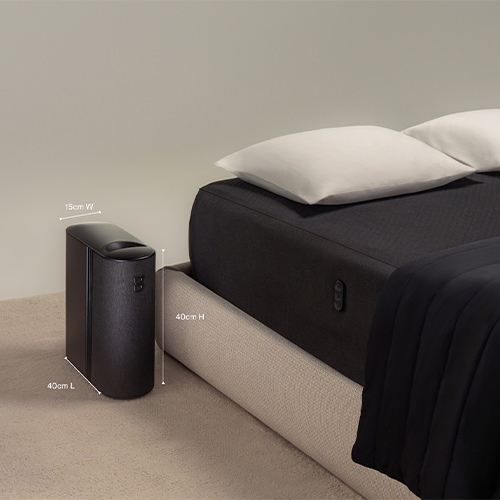
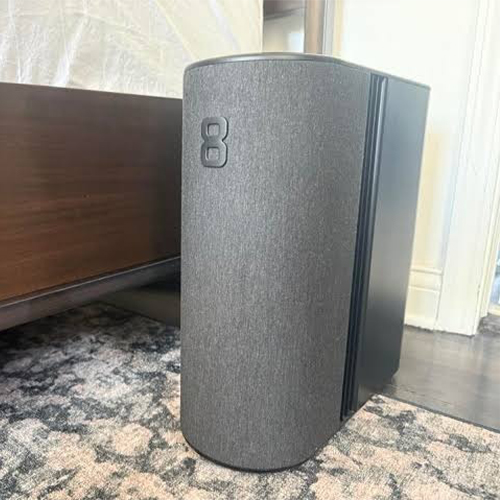
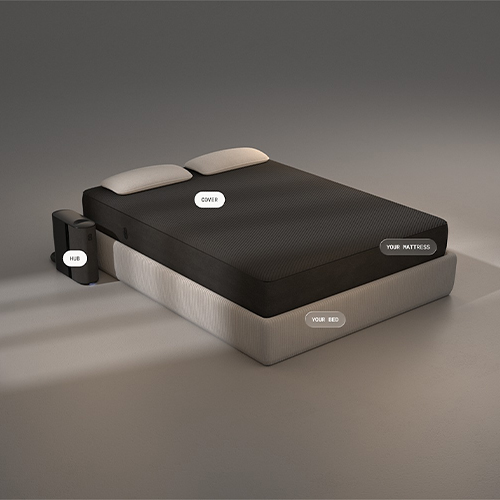
Temperature is the most overlooked factor in sleep quality. The Eight Sleep Pod 5 is the most complete solution to it — active surface cooling, dual zones, and Autopilot that adjusts all night.
Shop Eight Sleep Pod 5 — Official Site