

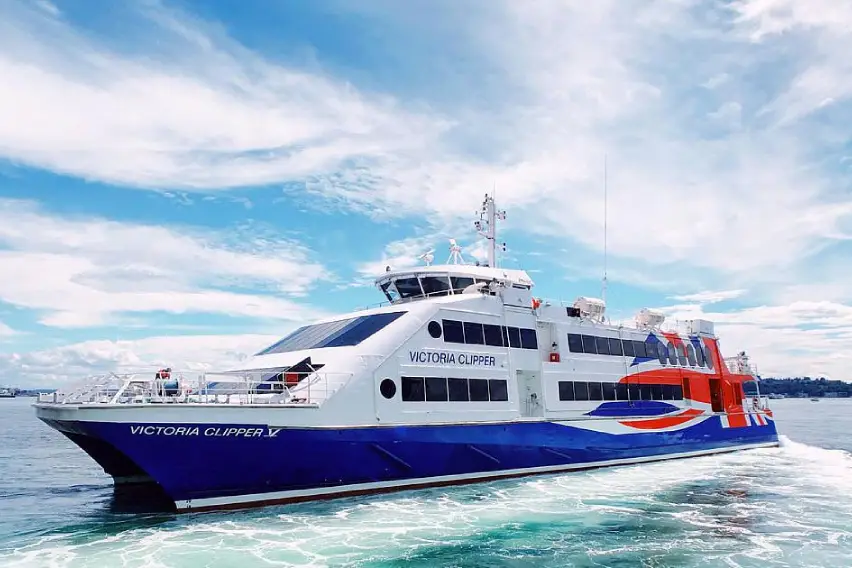
FRS Clipper runs one thing: a passenger-only catamaran between downtown Seattle and downtown Victoria. Done right, it is a lovely way to travel, and the operator’s safety history across decades is genuinely clean, which is not something every ferry company can say. The problem is that the service is contracting rather than growing. Summer sailings were halved in May 2025 with layoffs in Seattle, there is now one vessel making one daily round trip, and a seaplane operator launched the identical city pair in June 2026 at a $99 introductory fare, doing in roughly thirty minutes what the boat does in nearly three hours.
Fayes Homestyle Verdict Box
Category | Verdict |
Fayes Homestyle Score | 5.6 / 10 |
Best For | Travellers who want a downtown-to-downtown crossing without a car, and who value the scenery and the walk-on convenience over speed or price |
Typical Price | Roughly $120 to $160 one way per adult, varying sharply by season and booking date |
Standout Feature | Genuinely clean safety record: no collision, grounding, fatality or whale strike in the operating history we could document |
Biggest Catch | Summer sailings halved in May 2025, one vessel and one daily round trip, and the day trip currently not bookable off-season |
Reputation Note | Tripadvisor 4.1 from 2,390 reviews, but 12.7 percent rate it Poor or Terrible. BBB rates it D-minus, driven by three unanswered complaints |
Brand Snapshot, With the Corrections
The legal entity is Clipper Navigation Inc., a Seattle company, and it has traded as FRS Clipper since a 2020 rebrand. The older clippervacations.com address now redirects, which is why older guidebooks and blog posts point at a name that no longer appears on the tickets.

The ownership detail is routinely overstated. FRS, the German ferry group Förde Reederei Seetouristik, took a majority stake in January 2016. It was not an outright acquisition, and framing it as one misses that Clipper Navigation continued as the operating company. The honest phrasing is majority stake, 2016, with the Clipper operation continuing under the FRS brand from 2020.
The other correction concerns cars. This is a passenger-only service and has been since 1999. If you need a vehicle on Vancouver Island, this route cannot help you at all, and that single fact rules the service out for a large share of travellers before any other consideration.
The Service Is Getting Smaller
This is the central fact of any current review, and it is not a minor scheduling note.
In May 2025 FRS Clipper halved its summer sailings, accompanied by roughly twenty layoffs in Seattle. The operation now runs one vessel on one daily round trip in season. The same-day round trip, historically the service’s signature product for Seattle visitors wanting a day in Victoria, is currently not bookable outside the peak season.
For a traveller this changes the risk profile of booking. A single daily departure on a single vessel means no realistic recovery if that sailing is cancelled for weather or mechanical reasons; you are not catching the next one, because there is no next one. Combined with a $30 change fee, that is a thin margin for anything going wrong, and it is the main practical reason to be cautious about building a tight itinerary around this crossing.
The New Competition
On 11 June 2026, Harbour Air launched seaplane service on exactly the same downtown-Seattle-to-downtown-Victoria city pair, with a $99 introductory fare and a flight time of roughly thirty minutes.
That is a difficult comparison for a $120-to-$160 ferry ticket taking nearly three hours each way. The seaplane has real limitations, with tight baggage allowances, more weather sensitivity and small aircraft that do not suit everyone, and the ferry offers a far more comfortable passage with room to move around. But on the two metrics most travellers decide on, price and time, the ferry is now behind on both for the identical journey.
And the Cheaper Boat
The Coho ferry, running Port Angeles to Victoria, charges roughly $25 for a walk-on passenger and carries vehicles. That is not the same journey, since you have to get yourself to Port Angeles, but the price gap is large enough that for anyone with a car or flexible plans it reframes the FRS Clipper fare entirely. Paying roughly five times as much buys you the downtown Seattle departure and nothing else structural.
The Fees Nobody Mentions Until Checkout
Item | Cost | Note |
Adult fare, one way | Roughly $120 to $160 | Varies sharply by season and how early you book |
Baggage | $20 to $40 per bag per leg | Adds up fast on a round trip with two bags |
Change fee | $30 | On a service with one daily sailing, flexibility has real value |
Coho comparison, walk-on | Roughly $25 | Different departure port, carries vehicles |
Harbour Air seaplane | $99 introductory | Same city pair, roughly 30 minutes, from 11 June 2026 |
The baggage charge is the one that catches people. A couple travelling with a bag each on a round trip can add $80 to $160 to a fare they thought they had already paid, and it is not prominent in the booking flow.
“Lovely crossing and friendly crew, but the total cost once bags are added was a surprise” — Representative traveller theme, cross-referenced across Tripadvisor and Better Business Bureau filings
The Safety Record Is Genuinely Good
It would be easy to let the commercial problems colour this section, and that would be wrong, because the safety history is the strongest thing about the operation.
Across the documented operating history we found no collision, no grounding, no passenger or crew fatality and no whale strike, the last being a meaningful absence for a fast catamaran operating in waters with a resident orca population. There were two incidents involving contained fires, in 2013 and 2015, both in engine-space or electrical areas, and both resulted in zero injuries. For a high-speed passenger vessel running a demanding route for decades, that is a clean sheet by any reasonable standard, and it deserves to be stated as plainly as the criticisms.
Pros and Cons
Pros
- A genuinely clean safety record: no collision, grounding, fatality or whale strike, with two contained engine-space fires in 2013 and 2015 causing zero injuries
- True downtown-to-downtown travel, with no airport transfers, no rental car and no border queue in a vehicle line
- Tripadvisor 4.1 from 2,390 reviews, with crew friendliness and the scenery drawing consistent praise
- A comfortable passage with room to walk around, buy food and watch the water, which no thirty-minute flight offers
- Decades of continuous operation on the route, and genuine local knowledge of the crossing
Cons
- Summer sailings halved in May 2025 with roughly twenty Seattle layoffs, leaving one vessel and one daily round trip
- The same-day round trip is currently not bookable off-season, removing the service’s signature product for part of the year
- Harbour Air now flies the identical city pair from 11 June 2026 at a $99 introductory fare in roughly thirty minutes
- Baggage at $20 to $40 per bag per leg, plus a $30 change fee, on a service with no backup sailing
- Passenger-only since 1999, and BBB rates it D-minus over three unanswered complaints, with 12.7 percent of Tripadvisor reviewers rating it Poor or Terrible
How FRS Clipper Compares
Option | Price | Time | Takes cars |
FRS Clipper | $120 to $160 | Roughly 2 hours 45 minutes | No, since 1999 |
Harbour Air seaplane | $99 introductory | Roughly 30 minutes | No |
Coho, Port Angeles | Roughly $25 walk-on | Roughly 90 minutes plus drive | Yes |
BC Ferries via Tsawwassen | Varies | Longest, with land legs | Yes |
Who Should (and Shouldn't) Book It
Good Fit: Car-Free Downtown Travellers
If you are staying in downtown Seattle without a car, want to arrive in downtown Victoria on foot, and the crossing itself is part of the trip rather than an obstacle to it, this works well. The scenery is genuinely good, the crew reputation is solid, and the convenience of walking from hotel to terminal is real.
Weak Fit: Anyone on a Budget, a Schedule, or With a Car
If price decides, the Coho at roughly $25 wins outright. If time decides, Harbour Air now does the same city pair in a sixth of the time for less money. If you need a vehicle, this service cannot carry one. And if your itinerary has no slack, a single daily sailing on a single vessel with a $30 change fee is a risk worth weighing.

Our Top Pick in the Lineup
There is effectively one product, so the pick is a strategy rather than a sailing: book the peak-season crossing well in advance for the lower fare band, travel with one small bag to keep baggage fees down, and build a buffer day into your plans rather than connecting to anything tight on either end.
Pricing and Where to Buy
Book direct, where the full fare and the baggage and change terms are at least visible before payment. Fares move substantially with season and booking date, so the spread between $120 and $160 is largely a function of how early you commit. Check the schedule for your exact dates rather than assuming a daily service, because the post-2025 timetable is thinner than most published guidance reflects, and confirm whether the same-day round trip is available at all for your travel window.
Frequently Asked Questions
Does FRS Clipper carry cars?
No. The service has been passenger-only since 1999. If you need a vehicle on Vancouver Island, use the Coho from Port Angeles or BC Ferries instead.
Is the Seattle to Victoria day trip still available?
Not reliably. Summer sailings were halved in May 2025, the operation now runs one vessel on one daily round trip, and the same-day round trip is currently not bookable off-season. Check your exact dates before planning around it.
How does the price compare to the alternatives?
Expect roughly $120 to $160 one way, plus $20 to $40 per bag per leg. Harbour Air flies the same city pair from 11 June 2026 at a $99 introductory fare in about thirty minutes, and the Coho from Port Angeles charges roughly $25 for a walk-on passenger.
Is FRS Clipper safe?
Its record is genuinely clean. We found no collision, grounding, fatality or whale strike in the documented operating history. Two contained fires occurred in engine-space or electrical areas in 2013 and 2015, both with zero injuries.
Who owns FRS Clipper?
The operating company is Clipper Navigation Inc. of Seattle. The German ferry group FRS took a majority stake in January 2016, which was not an outright acquisition, and the business rebranded to FRS Clipper in 2020.
Fayes Homestyle Scorecard
Category | Score |
Safety Record | 9.5 / 10 |
Onboard Experience | 7.5 / 10 |
Value Against Alternatives | 3.5 / 10 |
Schedule Reliability and Choice | 3.0 / 10 |
Overall Fayes Homestyle Score | 5.6 / 10 |
Final Verdict
FRS Clipper is a good crossing attached to a shrinking business. The safety record is the best part of the story and should not be buried: decades of operation with no collision, grounding, fatality or whale strike, and two contained engine-space fires that injured nobody. The onboard experience earns its 4.1 Tripadvisor average, and downtown-to-downtown without a car is a genuine convenience nothing else on this route offers. But the commercial picture is going the wrong way. Sailings were halved in May 2025, one vessel now makes one daily round trip, the day trip has become seasonal, baggage and change fees inflate a fare that was already high, and since June 2026 a seaplane has flown the identical city pair in a sixth of the time for less money. Book it because you want the passage. Do not book it because it is the sensible way to get to Victoria, because as of now it mostly is not.
What do you think?