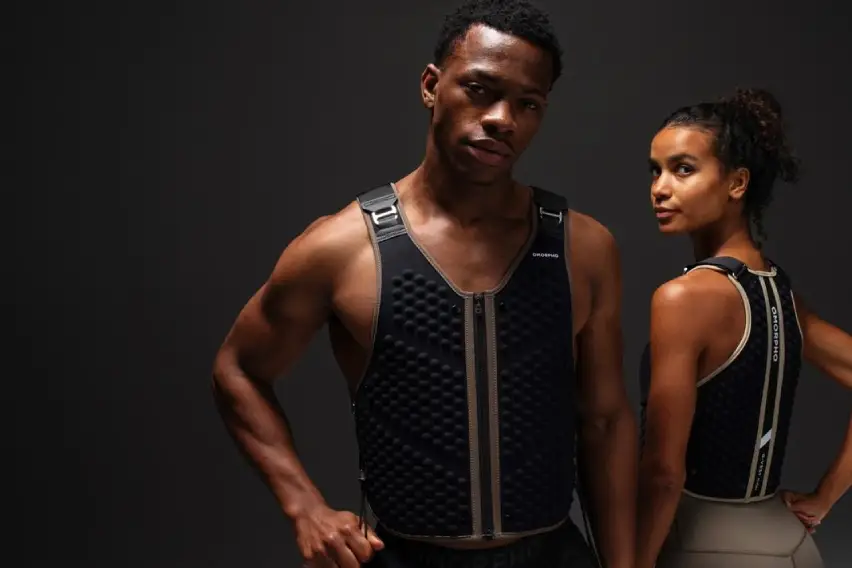
Every independent reviewer who has put an OMORPHO vest on agrees on one thing: it is the most comfortable weighted vest they have worn. That verdict comes from outlets with no shared interest, and the build quality scores back it up. The honest catch is that comfort is the only claim consistently verified. The three headline performance figures on OMORPHO’s own science page carry no citations at all, the only two studies testing OMORPHO products were never published and were co-written by the company’s own paid scientific advisor, and the amount of weight its apparel adds sits roughly an order of magnitude below the lightest load any published study has examined.
Fayes Homestyle Verdict Box
Category | Verdict |
Fayes Homestyle Score | 5.3 / 10 |
Best For | Buyers who specifically want a comfortable, low-bounce, slim-profile vest for running or HYROX training and are not buying it for a bone-density or performance claim |
Starting Price | G-Vest Icon $279-$299 (seen at $199); G-Pack add-on $99-$129; apparel $79-$139 |
Standout Feature | Comfort and low bounce, independently confirmed by five separate outlets, including 120 miles of marathon training with no chafing or balance problems |
Biggest Catch | There is no peer-reviewed, independently funded study of any OMORPHO product, and the three percentage claims on its science page have no citation attached to them |
Reputation Note | No lawsuits, FTC actions, recalls or data breaches found. Trustpilot shows 2.8/5 from only three reviews, which is not a usable sample in either direction |
OMORPHO makes a genuinely well-built, genuinely comfortable product and has a legitimate Fast Company innovation award behind it. The honest catch is that it is sold on a scientific story its own published evidence does not support, at two to four times the price per pound of capacity of a conventional vest.
Brand Snapshot
OMORPHO Inc. was founded in 2017 and launched publicly in November 2021 after about three years of development, based in Portland, Oregon. It trades as Gravity Sportswear and brands its weighting technology MicroLoad. One correction worth making: it has two co-founders, not one. Stefan Olander, a senior Nike executive for more than two decades, is co-founder and CEO; Ben Williams is the other co-founder, and former Nike designer Natalie Candrian leads design. Olander’s exact Nike title is reported inconsistently across outlets as VP of Digital Sport and VP of Global Digital Innovation, so we are not stating one.

The company is independent and venture-backed, having raised somewhere between roughly $16 million and $18 million across five rounds, depending which source you take; the figures published by the company and by trade press do not reconcile. Round sizes have shrunk over time, from $6 million in 2022 to $3 million in 2023 to $2.3 million in late 2024, and the most recent round is now nearly two years old. It is clearly still trading and expanding, having launched into the UK and Europe in June 2026 and released an officially branded HYROX vest in August 2026.
Two things are worth naming honestly. The weights are not one system but two: the vests use hundreds of small stainless steel ball bearings in panels, while the apparel uses high-density polymer spheres bonded to the outside of the fabric. And there are no weighted gloves, despite that being a common assumption; the range is vests plus tops, tanks, tights and shorts.
What You Actually Get, and What It Costs
Product | List price | Base weight | Max weight |
G-Vest Icon (men’s) | $299 (seen at $199) | 10 lb | 20 lb with G-Pack |
G-Vest Icon (women’s) | $279 | 6 lb | 12 lb with G-Pack |
G-Vest Run | $279 | 6 lb | 16 lb with G-Pack |
G-Pack add-on | $99 bundled / $129 alone | 3 snap-in panels | — |
G-Wear apparel (tops, tights) | $79-$139 | 1-3 lb, fixed | Not adjustable |
Note that earlier generations of the G-Vest had fixed, non-adjustable weight, and most of the big independent reviews tested that version. The current Icon line is adjustable via the snap-in G-Pack, so the common criticism that you cannot add or remove weight no longer applies. The apparel, however, is still fixed weight.
Two pricing observations worth making. The G-Pack being a separate purchase at $99 to $129 on top of a $299 vest drew a direct complaint from one reviewer, who called it a little cheeky at that price. And the discounting is heavy and persistent: a flagship vest at $199 against a $299 list, apparel at $79 against $119, and a site-wide sale banner. A brand confident in premium positioning does not discount its flagship by a third.
The Science Page, Examined Line by Line
This is the section that matters most, because the entire premium rests on it. OMORPHO’s science page makes three headline claims: that MicroLoad can increase bone mineral density by 2.8 percent, increase VO2 max by up to 7.2 percent, and help you lose 2 percent more body weight and 4 percent more fat without losing muscle. It also says the approach is supported by over 20 studies published between 1985 and 2021.
Here is what we found when we checked. None of those three percentages has a citation attached to it anywhere on the page. The page lists eleven references, not over twenty, which overstates the brand’s own evidence base roughly twofold. Of those eleven, exactly two test an actual OMORPHO product, and both are unpublished company reports with no journal, no volume and no DOI; we could find no trace of either in any literature database. Both were co-authored by Erin Feser, who is OMORPHO’s own Scientific Advisor, and who also appears on three of the peer-reviewed references. That is a disclosable conflict of interest on one hundred percent of the product-specific evidence.
The peer-reviewed references largely do not test what OMORPHO sells. They examine limb-mounted resistance on sprinters, footballers and rugby players, or heavy trunk loading, rather than one to two pounds distributed across the torso of a general exerciser. One cited study is explicitly a single-case design with one participant. No sample sizes appear anywhere on the page, one DOI is malformed, and one journal name is misspelled.
The Load Problem, in Numbers
This is the clearest way to understand the gap. A 2017 systematic review in Sports Medicine, covering 32 studies, found that trunk loading had been studied at 7 to 30 percent of body mass. For a 175-pound person, OMORPHO’s apparel adds 1 to 3 pounds, which is roughly 0.6 to 1.7 percent of body mass. The men’s base vest at 10 pounds is about 5.7 percent; fully loaded at 20 pounds it reaches about 11.4 percent. So the apparel sits an order of magnitude below the lightest trunk load ever studied, the base vest sits below the studied range, and only a fully loaded men’s vest reaches the bottom of it.
There is also a claim-drift problem worth noting. At its 2021 launch, OMORPHO publicised an entirely different set of numbers: 9 percent more vertical jump, 8 percent more power, 3 percent more speed, 8 percent more calories burned. None of those figures appears on the current science page. The claim set has been swapped out wholesale, and neither version is traceable to a named citation on the brand’s own site.
One more precision point. OMORPHO holds a genuine granted US utility patent plus three design patents, and markets this as patented science. A patent certifies that a design is novel and non-obvious. It says nothing whatsoever about whether the product works. Those are two different things and the phrase conflates them.
What the Independent Research Says About Weighted Vests Generally
The strongest evidence in the wider category runs against the bone-density premise. A twelve-month randomised trial published in JAMA Network Open in June 2025, funded by the National Institute on Aging rather than industry, followed 150 older adults with obesity across three arms: weight loss alone, weight loss plus a weighted vest worn an average of 7.1 hours a day, and weight loss plus resistance training. All three arms lost similar weight, and all three showed similar significant decreases in hip bone mineral density. Neither the vest nor the resistance training prevented bone loss.
In September 2025, Osteoporosis Canada published a position statement that does not recommend weighted vests for bone health, finding little to no evidence that a vest raises bone mineral density during walking or everyday activity, and noting that bone takes eight months or more to study properly, so six to eight week results are unreliable. Exercise scientists interviewed by NPR in August 2025 made a related point: the main risk is substitution, people using a vest instead of proven strength training, rather than the vest causing harm. One noted fairly that added weight does raise energy expenditure, so there is a genuine if small cardiovascular effect.
On safety, the honest picture is reassuring rather than alarming. Added load raises spinal forces, particularly in bending and twisting, and back pain and discomfort were reported by participants in all-day vest studies. But no independent source reported gait damage, joint injury or balance problems specific to OMORPHO, and one reviewer ran 120 miles in the vest while marathon training with no issues at all. The honest risk here is ineffectiveness and substitution, not danger.
Pros and Cons
Pros
- Comfort is independently confirmed by five separate outlets, including a Most Comfortable Weighted Vest award and 120 miles of marathon training with no chafing
- Build quality rated 4.5 out of 5 by the most rigorous reviewer, its highest sub-score, with a locking zipper and well-regarded adjustment hardware
- A legitimate, independently verified Fast Company World’s Most Innovative Companies 2023 award, ranked seventh in the Wellness category
- No weights shifting or detaching was reported by any source; one outlet specifically tested for it and confirmed they stayed put
- Real institutional validation: stocked at DICK’S House of Sport, an Equinox partnership, and the only weighted vest carrying official HYROX branding
Cons
- No peer-reviewed, independently funded study of any OMORPHO product exists; the only product-specific evidence is two unpublished reports co-authored by the company’s own paid advisor
- The three headline percentage claims on the science page carry no citations, and “over 20 studies” is supported by eleven listed references
- The apparel’s load sits roughly an order of magnitude below the lightest trunk load any published study has examined
- Roughly two to four times the price per pound of capacity of conventional vests, with a 20 lb men’s ceiling that sits below where most rivals start
- Restricts spinal flexion and extension, making it poor for yoga backbends, mat work and floor-lying exercises
How It Tests Against Conventional Vests
Vest | Price | Weight range | Independent score |
REP Strata | from $87.99 | 10-40 lb | 4.5 / 5 |
Rogue Plate Carrier | $135-$165 | 5-40 lb | 4.3 / 5 |
GORUCK Ruck Plate Carrier 3.0 | from $115 | up to 45 lb | 4.2 / 5 |
OMORPHO G-Vest+ | $299 | fixed ~10 lb (tested gen) | 3.8 / 5 |
Hyperwear Hyper Vest Elite | from $230 | up to 20-25 lb | comfort 4.5 / durability 3.5 |
The value arithmetic is unflattering. A fully loaded men’s OMORPHO runs $400 to $430 once you add the G-Pack, for a 20-pound ceiling. For less than that you could buy both a REP Strata and a Rogue Plate Carrier and have four times the maximum load. What the premium buys is comfort, low bounce, a slim profile and looks, all of which are independently confirmed. It does not buy more load, more adjustability or better evidence.
“The science behind microloading is unproven, and gains for the average athlete are likely to be small” — Representative conclusion from the most rigorous independent review of the G-Vest
The pattern across every professional review is consistent: unanimous on comfort, design and build quality; unanimous that price is the main drawback; unanimous that the maximum weight is light for strength athletes; and split on whether the training effect is meaningful. Notably, only two outlets engage with the evidence base at all, and both are sceptical. Consumer Reports has tested an OMORPHO vest alongside five rivals, but its scores sit behind a paywall.
What Customers Report
The independent review footprint is extremely thin, and we would rather say so than present a number as meaningful. Trustpilot shows 2.8 out of 5 from exactly three reviews, on an unclaimed profile where the company has not invited reviews. Three reviews cannot characterise a brand, and we are not treating that figure as a verdict. No BBB profile could be located. Thingtesting has a brand page with zero reviews.
Meanwhile OMORPHO’s own site displays a 4.8 average and 96 percent recommendation rate with no review count shown anywhere. The gap between a 4.8 vendor-hosted figure with no sample size and a 2.8 across three third-party reviews cannot be reconciled from public data, and for a brand four years into direct-to-consumer trading, the near-total absence of independent review volume is itself the finding.
Where complaints are documented across multiple sources, they are consistent: price above all, maximum weight too light for strength athletes, narrow sizing with only two size bands per product, pressure points at the hip and sides, restricted spinal movement, and the raised-sphere texture feeling odd in leggings. Availability has also been a problem, with waitlists and some products unavailable for two to three months, and OMORPHO’s own apparel page has carried a limited-inventory notice.
One correction worth making in the brand’s favour: despite being an obvious thing to worry about, no source anywhere reported weights shifting, detaching or coming loose. One outlet explicitly tested for it and found they stayed put through squat jumps, burpees and swings.
The Athlete Endorsements Are Paid
OMORPHO’s roster includes an All-Pro NFL linebacker, a Super Bowl-winning return specialist, an MLS captain, an Olympic bronze medallist and a world champion high jumper. These are presented in a way that can read as organic adoption. They are not. OMORPHO’s own blog uses the language of contracts throughout, signs, re-signs, partners with, and it runs an NFL ambassadors programme. Worth noting too that Madison Square Garden Sports Corp is an investor, so any team exposure in that orbit is financially entangled rather than independent. We found no documented instance of genuinely organic, unpaid athlete adoption.

Who Should (and Shouldn't) Buy OMORPHO
Good Fit: Runners and HYROX Athletes Who Want Comfort
If you want a vest that genuinely does not bounce, chafe or throw off your balance while running, and you are buying it as a comfortable way to add modest load, the independent testing supports that choice without reservation.
Weak Fit: Anyone Buying for Bone Density or Serious Strength Work
If bone health is your reason, the largest, longest, independently funded trial in this category found vests did not prevent bone loss, and Osteoporosis Canada does not recommend them for that purpose. And if you want progressive overload, a 20-pound ceiling at $400 is poor value against vests starting at $88 that reach 40 pounds.
Our Top Pick in the Lineup
The G-Vest Icon with the G-Pack is the pick, because it is the only configuration that reaches a load the published research has actually studied. If you buy anything here, buy the vest rather than the apparel, since the apparel’s one to three pounds sits well below any studied threshold.
Pricing and Where to Buy
OMORPHO sells direct through its own US and European stores, plus DICK’S House of Sport and a handful of specialist retailers. Given how consistently it discounts, buying at list price is unnecessary. Note that reported return terms differ across sources, from a 30-day unworn window to a 60-day money-back guarantee, and one customer reported paying around $20 in return shipping despite free returns being advertised; check the policy at the moment you buy.
Frequently Asked Questions
Does OMORPHO's weighted clothing actually improve performance?
There is no peer-reviewed, independently funded study of any OMORPHO product. The only product-specific evidence is two unpublished company reports co-authored by OMORPHO’s own scientific advisor, and the three headline percentages on its science page carry no citations at all.
Will a weighted vest improve my bone density?
The best available evidence says no. A twelve-month, NIH-funded randomised trial published in 2025 found that a weighted vest worn over seven hours a day did not prevent hip bone density loss, and Osteoporosis Canada’s 2025 position statement does not recommend vests for bone health.
Is OMORPHO worth the price versus a normal weighted vest?
Only if comfort is what you are paying for. A fully loaded men’s OMORPHO costs $400 to $430 for a 20 lb ceiling, while conventional vests start around $88 and reach 40 lb. The comfort advantage is real and independently confirmed; the load and price advantage runs the other way.
Do the weights fall off or shift around?
No. This is a genuine point in the brand’s favour. No independent source reported weights shifting or detaching, and one reviewer specifically tested for it through squat jumps, burpees and swings, confirming they stayed in place.
Are OMORPHO's athletes genuine users or paid endorsers?
They are paid. OMORPHO’s own communications describe signing and re-signing athletes and running an ambassador programme, and one of its investors is a professional sports holding company. We found no documented case of unpaid, organic adoption.
Fayes Homestyle Scorecard
Category | Score |
Comfort and Build Quality | 9.0 / 10 |
Evidence Behind Performance Claims | 2.0 / 10 |
Value Per Pound of Capacity | 3.5 / 10 |
Legal and Safety Record | 9.0 / 10 |
Overall Fayes Homestyle Score | 5.3 / 10 |
Final Verdict
OMORPHO has built something people genuinely like wearing. The comfort advantage over a conventional weighted vest is real, independently confirmed by five outlets with no shared interest, and the build quality earns its highest marks from the toughest reviewer. The legal and safety record is clean, the Fast Company award is legitimate, and nobody reported the weights coming loose. The honest catch is that comfort is a comfort claim, not a performance claim, and the performance story the price is built on does not survive a careful read. Three headline percentages with no citations, eleven references presented as over twenty, the only two product studies unpublished and written by the company’s own advisor, and a load an order of magnitude below anything the research has tested. Buy it because it is the nicest vest to wear. Do not buy it expecting your bones, your VO2 max or your body composition to do what the science page says they will.
What do you think?