

The short version, before you scroll
Emma Bridgewater is the rare British heritage brand where the heritage claim survives checking. The pottery really is still made and hand-decorated at the Hanley factory in Stoke-on-Trent, it carries a two-year guarantee with a named claims route for crazing, and it holds 4.5 out of 5 from more than eighty-five thousand Trustpilot reviews, which is the most solid customer dataset we have seen on any brand this month. It has also lost money for three years running and cut jobs twice. The good news is that the 2026 numbers are moving the right way, and unlike several of its Stoke neighbours it has not gone under.
Quick facts
|
|
Fayes Homestyle Score | 7.5 / 10 |
Founded | 1985 by Emma Bridgewater, after failing to find a cup and saucer for her mother |
Legal entity | Emma Bridgewater Limited, company number 01943787 |
Ownership | Private, backed by BGF: £8m invested in 2020 plus a further £2.2m in May 2024 |
Factory | Hanley, Stoke-on-Trent. Site bought 1995, production from 1996. Around 350 staff today |
Prices | Polka Dot half pint mug £26, dinner plate £28, half pint jug £30, butter dish £45 |
Trustpilot | 4.5 out of 5 from 85,133 reviews. 83 percent five star, 6 percent one star |
Guarantee | Two years. Faulty items within 30 days get a free prepaid return label |
Certification | B Corp certified since January 2022 |
Recalls and lawsuits | None found |
Is it still actually made in England?
Yes, and we want to be precise about it because this is the question most people are really asking.
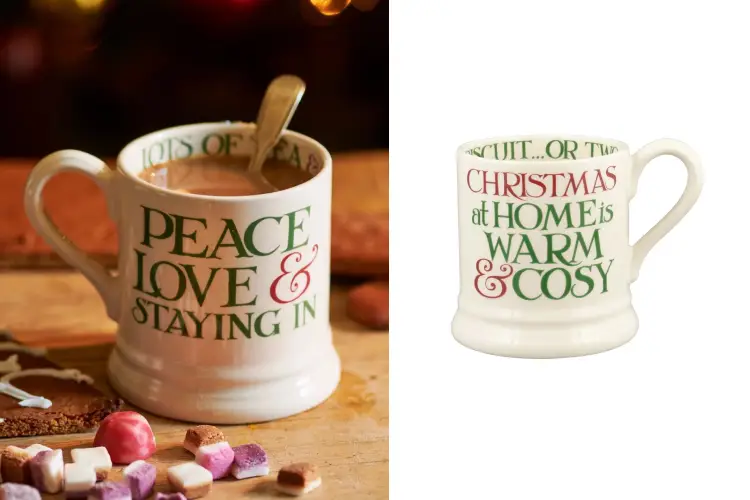
The Hanley factory in Stoke-on-Trent is active. The company bought the site in 1995 and has been producing there since 1996. As of early 2026 it reported hiring more skilled decorators, had staff on overtime from the start of the year, and employs around 350 people across the factory, the retail shops, the decorating studio, the café, a distribution centre at Meir, a London office and a store at Bicester Village. Product pages state 100 percent English earthenware, handcrafted and hand-decorated in Stoke-on-Trent, made in the United Kingdom.
Now the caveat, which is important and which most reviews miss. That applies to the pottery. The catalogue also carries enamelware, tins, trays and a rice husk travel cup, and the pages we read do not state an origin for any of those lines.
Non-pottery item | Price | Origin |
Polka Dot Large Enamel Jug | £32 | Not stated |
Enamel Roasting Dish 34cm | £45 | Not stated |
Set of 3 Square Cake Tins | £45 | Not stated |
Round Tin Tray | £10 | Not stated |
Rice Husk Travel Cup | £10 | Not stated |
So do not let made in Stoke bleed across the whole range. If British manufacture is why you are buying, buy the earthenware, not the enamel.
So who actually owns it now?
Emma Bridgewater founded the business in 1985 after she could not find a suitable cup and saucer as a gift for her mother and decided to make her own. Her husband Matthew Rice has long been associated with the design side. The legal entity is Emma Bridgewater Limited, company number 01943787, with a related entity, Bridgewater Pottery Limited, also on the register.
It is no longer purely a family business. BGF, the Business Growth Fund, invested £8 million in 2020 and a further £2.2 million in May 2024. BGF’s exact stake is not disclosed and we could not find it. There has been no trade sale, so this remains a private, institutionally backed company rather than either an independent family firm or a conglomerate subsidiary.
We think that is the right framing for a buyer. The second investment in 2024 came in the middle of the loss-making years, which tells you the backer chose to put more money in rather than pull out. That is a meaningful signal about the turnaround plan, and it is the main reason this brand is in a different position from several Stoke neighbours that have collapsed.
The money, because you should know before you buy a gift card
Three consecutive loss-making years. Here is the trajectory.
Year to | Turnover | Result |
April 2022 | £33.0m to £33.1m | £1.1m pre-tax profit. The last profitable year |
May 2023 | £36.2m, up 9 percent | £1.38m pre-tax operating loss |
27 April 2024 | £31.5m, down 16 percent | £4.4m pre-tax loss |
26 April 2025 | £27.4m, down 12 percent | £2.4m loss after tax, with gross profit up to £14.0m from £13.0m |
One note on the figures. The sources we used cite slightly different turnover bases for the same years, £36.2m against £37.7m for the 2023 year and £31.5m against £31.3m for 2024, most likely operating versus total turnover. We are presenting ranges rather than pretending to a precision we do not have.
The restructuring was real. Around forty factory roles were cut in summer 2023 and thirty-six more in February 2024. The Stoke factory ran two separate ten-week periods of short-time working. Headcount fell from 469 to 409 across the 2024 financial year. The board’s language was workforce optimisation and reduced production schedules, with a stated focus on reducing the fixed cost base.
The detail worth holding onto is that gross profit rose in the most recent year even as turnover fell. That is what a margin-led turnaround looks like: selling less, but selling it better.
What changed in 2026, and is the recovery real?
It looks real, and we are going to list the numbers rather than summarise them because the specificity is the point.
- Sales for the first eight months to December 2025 up 12 percent.
- The final thirteen weeks of that period up 17 percent.
- Halloween up 35 percent, Black Friday up 24 percent, Christmas up 8 percent.
- New customers up 33 percent across October to December.
Chief executive Iain Martin says the plan is on track to return the business to profitable growth in the 2025/26 financial year. New leadership has been recruited largely from outside the pottery industry, with Meg Mackintosh, previously at The White Company and Jo Malone, appointed creative director. The strategy is a tighter range, a sharper focus on the core customer, less discounting and better margins.
Product activity through 2026 backs that up: Valentine’s and Mother’s Day ranges launched in January, a new Easter range, Black Hearts mugs selling alongside The Traitors, a partnership described as hugely successful with Diddly Squat Farm, and a first Studio Series collaboration with the dog artist Jenny Bloomfield.
Context matters here, and it is brutal. Denby has closed. Burleigh collapsed into administration with around five hundred jobs at risk before being rescued in a last-minute deal that saved all of them. Portmeirion reported a £3.5 million pre-tax loss. Royal Stafford and Moorcroft have both gone. Against that backdrop, a company that is loss-making but institutionally backed, trading up double digits and still firing its kilns is in genuinely better shape than most of its street.
What does it cost?
Item | Price |
Polka Dot Small Mug | £20 |
Polka Dot half pint mug, and Daddy and Mummy versions | £26 each |
Black Toast All Over Writing half pint mug | £26, currently out of stock |
Medium Dinner Plate 8.5 inch | £25 |
Cereal Bowl, French Bowl | £25 each |
Large Dinner Plate 10.5 inch, Medium Pasta Bowl | £28 each |
Half Pint Jug | £30 |
Personalised half pint mug | From £35 |
Small Butter Dish | £45 |
Polka Dot Mr and Mrs boxed pair of half pint mugs | £52 |
Personalised four-mug teapot | From £88 |
Multibuy sets of four run at roughly 20 percent off, so 8.5 inch plates drop from £100 to £80 and pasta bowls from £112 to £89.60. A 15 percent offer on two half pint mugs was advertised but was not reflected in the listed mug prices when we checked. Black Friday 2026 carried 30 percent off selected enamel, taking the roasting dish from £45 to £31.50 and the large enamel jug from £32 to £22.40.
Free UK delivery over £50. UK standard delivery is three to five working days and the international target is fourteen days.
The seconds channel, and whether it is worth it
There is a dedicated seconds collection: pieces hand-inspected and sold with what the brand calls unique blemishes, described as structurally sound with small marks or paint imperfections.
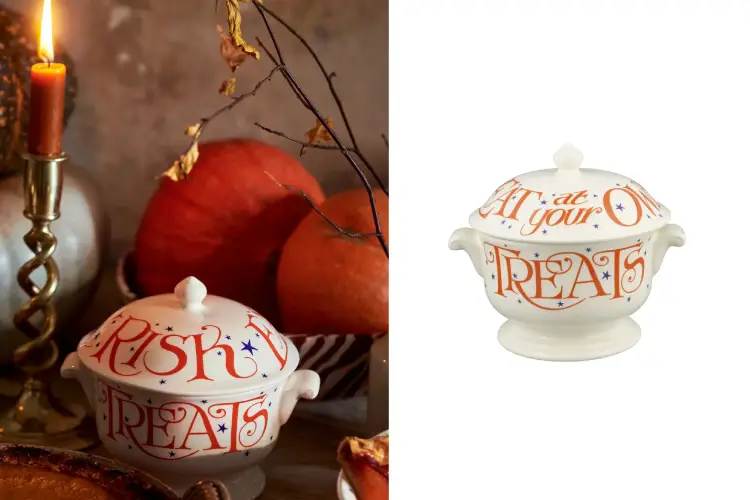
The honest finding is that the discount is modest.
Seconds item | Seconds price | First-quality price |
Half Pint Mug | £22.10 | £26.00 |
Large Dinner Plate 10.5 inch | £23.80 | £28.00 |
Soup Plate | £23.80 | Not listed |
Black Toast French Bowl | £21.25 | £25.00 |
Big Blue Star Big Daddy Large Mug | £27.20 | Not listed |
Pink Hearts four-mug teapot | £59.50 | Not listed |
Black Toast Medium Straight Jug | £46.75 | Not listed |
Roughly 15 percent off for a piece with acknowledged cosmetic faults is not a bargain, and we would rather buy first-quality in a multibuy set at 20 percent off than a single second at 15 percent. The multibuy maths is simply better.
One gap to flag: no seconds-specific returns policy is stated. Seconds sold with acknowledged blemishes, sitting under a general returns policy, is ambiguous. If you buy seconds, ask what counts as a fault versus an expected blemish before you order.
The fine print, and this part is genuinely good
Emma Bridgewater has the strongest after-sales terms of any brand we have looked at recently, and that deserves saying clearly.
- Products are guaranteed for two years.
- Faulty or damaged items: contact within 30 days of delivery and you get a free prepaid return label, then a replacement or refund. Photos or proof of purchase may be required.
- Crazing has its own named claims route. Email customer services with the purchase date, proof of purchase and photos.
- Unwanted items: you pay £6 for an EVRi return. The return window for unwanted items is not stated on the FAQ page, which is the one real gap.
- Personalised orders are final at the point of order, with no refund or replacement. Non-personalised orders cannot be cancelled once confirmed.
- Some items are non-returnable for hygiene reasons unless faulty.
The crazing route is worth dwelling on, because it cuts both ways. Crazing, the fine network of surface cracks that develops in glaze, is the classic failure mode of earthenware. The fact that this company has a dedicated claims process for it is reassuring: they will deal with it. It is also an admission that it happens often enough to need a process. Both of those things are true and you should know both.
The personalisation rule is the one that catches people. Final at the point of order means final the moment you click, not after dispatch. One Trustpilot complaint we saw described a personalisation preview not being clearly shown during ordering, producing the wrong orientation. Check your preview carefully, because there is no route back.
How should you actually use it?
- Dishwasher safe. The brand recommends liquid detergent to preserve the appearance.
- Microwave: not recommended. This is earthenware and it gets hot.
- Not oven safe, unless the specific item is marked as cookware.
That microwave answer surprises people who have bought the mugs as everyday mugs, so it is worth being blunt: this is a £26 mug you should not microwave. If you reheat your tea, buy something else.
What do owners say actually goes wrong?
Trustpilot | Share |
Five star | 83 percent |
Four star | 6 percent |
Three star | 3 percent |
Two star | 2 percent |
One star | 6 percent |
Overall | 4.5 out of 5 from 85,133 reviews, 8,494 of them in the last twelve months |
Eighty-five thousand reviews is a genuinely robust dataset and an 89 percent combined four-and-five-star share across it is a strong result. One disclosure: the profile has been claimed since February 2018 and the company holds a paid Trustpilot subscription, which means it can invite reviews. That does not invalidate the score at this volume, but you should know it. There is also a separate Trustpilot location profile for the Stoke factory.
“Delivery and courier problems are the dominant negative theme, covering delays, missing parcels, breakage in transit and poor packaging” — Themes estimated from the visible recent Trustpilot reviews, roughly four of twenty-four
- Delivery and courier problems, the clear leading complaint: delays, missing parcels, items broken in transit and packaging judged inadequate for ceramics.
- Unhelpful customer service, or items arriving damaged or marked, roughly two of twenty-four recent visible reviews.
- Personalisation preview not clearly shown during ordering, resulting in wrong orientation, one report.
Those are small-sample estimates from the visible recent reviews rather than a platform-wide breakdown, and we are presenting them as directional. The pattern is consistent with the category though: the risk in buying ceramics online is the journey, not the pot.
No recalls were found. No lawsuits were found. The company has been B Corp certified since January 2022, though we could not confirm whether recertification has taken place, which is worth noting since B Corp status requires periodic renewal.
Who should buy it, and who should walk away
Buy it if you want British-made pottery and you mean it
This is the central case. The earthenware really is made and hand-decorated in Stoke-on-Trent, by around 350 people at a factory the company owns, with a two-year guarantee behind it. Very little else in the category can say that and prove it.
Buy a multibuy set rather than single pieces
Roughly 20 percent off four plates or four pasta bowls is the best value in the catalogue, better than the seconds channel at 15 percent, and it gets you a matched set rather than a lone mug.
Walk away if you need a microwaveable mug
It is not recommended, and that is not a small caveat on a £26 mug people buy to drink tea from. Earthenware gets hot. Buy porcelain or stoneware if reheating matters.
Walk away from personalised items unless you are certain
Final at the point of order, with no refund or replacement, and at least one complaint about the preview not being clear. Personalisation here is a one-shot commitment.
And do not buy a gift card
This is the one firm negative we will draw from the financials. A company with three consecutive loss-making years, two rounds of redundancies and a turnaround still in progress is a company whose products you can buy with confidence and whose stored credit you should not hold. That is not a prediction of failure, and the 2026 trading figures are encouraging. It is simply that a mug in your cupboard carries no counterparty risk and a gift card does.
If you buy one Emma Bridgewater thing, buy this one
A set of four Polka Dot or Black Toast plates on the multibuy offer, at £80 to £89.60 for four rather than £25 to £28 each. It is the best value in the catalogue, it gets you the actual Stoke-made earthenware rather than the enamel lines whose origin is not stated, and plates take less daily abuse than mugs so the crazing question is less pressing. If you want a single piece to start with, the £20 Polka Dot small mug is the cheapest route into the real product, just do not microwave it. Avoid the seconds channel at only 15 percent off, avoid personalisation on a first order, and skip the gift card.
Questions people actually ask
Is Emma Bridgewater still made in England?
The pottery is, yes. It is made and hand-decorated at the Hanley factory in Stoke-on-Trent, which the company has owned since 1995 and produced at since 1996, employing around 350 people across the factory and its other sites. Product pages state 100 percent English earthenware made in the United Kingdom. But the non-pottery lines, the enamelware, tins, trays and the rice husk travel cup, carry no stated origin on the pages we read.
Who owns Emma Bridgewater?
It is a private company, Emma Bridgewater Limited, company number 01943787, founded by Emma Bridgewater in 1985 and backed by BGF, which invested £8 million in 2020 and a further £2.2 million in May 2024. BGF’s stake size is not disclosed. There has been no trade sale.
Can you microwave Emma Bridgewater mugs?
It is not recommended. This is earthenware and it gets hot in a microwave. The pottery is dishwasher safe, with liquid detergent recommended to preserve the appearance, and it is not oven safe unless the specific item is marked as cookware.
Is Emma Bridgewater in financial trouble?
It has lost money for three consecutive years, with a £1.38m loss in the year to May 2023, £4.4m in the year to April 2024 and £2.4m after tax in the year to April 2025, alongside two rounds of redundancies and two ten-week periods of short-time working. But gross profit rose in the most recent year, BGF put more money in during the loss period, the chief executive says the business is on track to return to profitable growth in 2025/26, and trading for the eight months to December 2025 was up 12 percent. Unlike Denby, Burleigh, Royal Stafford and Moorcroft, it has not entered administration.
What is Emma Bridgewater's guarantee?
Two years on products. Faulty or damaged items reported within 30 days of delivery get a free prepaid return label and a replacement or refund. Crazing has its own dedicated claims route by email with purchase date, proof of purchase and photos. Unwanted items cost you £6 for an EVRi return, and the window for those is not stated. Personalised items are final at the point of order.
Are Emma Bridgewater seconds worth buying?
Only marginally. A seconds half pint mug is £22.10 against £26 first quality, so roughly 15 percent off for an acknowledged cosmetic blemish, while multibuy sets of four first-quality pieces run at about 20 percent off. There is also no seconds-specific returns policy stated, so ask what counts as a fault rather than an expected blemish before ordering.
Does Emma Bridgewater pottery craze?
Earthenware crazes, and the company has a dedicated claims process for it, which is both reassuring and telling. If it happens, email customer services with the purchase date, proof of purchase and photos. The two-year guarantee covers you.
Fayes Homestyle Scorecard
|
|
British manufacturing, verified | 9.5 / 10 |
Guarantee and after-sales terms | 9.0 / 10 |
Customer reviews at volume | 8.5 / 10 |
Design and range | 8.5 / 10 |
Ethical certification | 7.5 / 10 |
Everyday practicality | 6.0 / 10 |
Value for money | 6.0 / 10 |
Delivery and packaging | 5.0 / 10 |
Financial stability | 4.5 / 10 |
Overall Fayes Homestyle Score | 7.5 / 10 |
The bottom line
Emma Bridgewater is the best-documented brand in this batch and the one we would most readily buy from. The earthenware really is made and hand-decorated at a factory the company owns in Stoke-on-Trent, employing around 350 people, with more decorators hired and staff on overtime through 2026. Products are guaranteed for two years, faulty items inside 30 days get a free prepaid return label, and crazing, the classic earthenware failure, has its own named claims route. It holds 4.5 out of 5 from 85,133 Trustpilot reviews with 83 percent five star, it has been B Corp certified since January 2022, and there are no recalls and no lawsuits.
The qualifications are real and they are mostly about the company rather than the pottery. Three consecutive loss-making years, £4.4m in 2024 and £2.4m in 2025, two rounds of redundancies, headcount down from 469 to 409 and two ten-week spells of short-time working. BGF money rather than pure family ownership. Mugs you should not microwave, which catches people out at £26 a piece. Personalised orders final the moment you click. A seconds channel at only 15 percent off. Enamel and tin lines with no stated country of origin. And courier damage as the leading complaint in a category where the journey is the risk.
Buy the multibuy plate set, buy the pottery rather than the enamel if British manufacture is the point, check your personalisation preview twice, and do not buy a gift card. On current trading the recovery looks real, and in a street where Denby, Burleigh, Royal Stafford and Moorcroft have all fallen over, still firing the kilns counts for something.
What do you think?